For DTC and Shopify operators
Put AI through your catalog and lifecycle without wrecking the brand.
A 101-page field manual for the person who actually runs the store: 34 workflows across catalog operations, listing copy, merchandising, lifecycle messaging, support triage and the weekly reporting cycle, each with the review gate that keeps it safe to run at volume.
A paid digital book, not software: one 101-page PDF, sold once for $79. Independent publisher, not affiliated with Anthropic, OpenAI, or Shopify.
Instant access after checkout, plus a link emailed to you. Payment is handled by Stripe. 60-day refund, no questions asked. Or read chapter three first, no email needed.
- 101 pages, 12 chapters
- 34 documented workflows
- Verified against the vendor docs, July 2026
- Platform-agnostic
What's in the box
One PDF. Five things you will actually use.
"101-page PDF" undersells it. Here is what the file contains, in the order you will meet it.
The field manual 12 chapters
Where AI actually pays in a store, the workspace setup, the brand context file, the anatomy of a working prompt, then workflow by workflow: listings, ad creative, lifecycle, support, analytics and research, finishing with the pitfalls chapter and how to make it all a habit.
The workflow library 34 workflows
Each workflow has the same four parts: the files the agent reads as its source of truth, the prompt in full, what it is explicitly forbidden to invent, and the review step that has to pass before anything reaches a customer.
Weak and strong, side by side Annotated
Every prompt is printed next to the weaker version of the same request, with what the difference buys you. The contrast is the teaching; the prompt is the artifact.
The pitfalls chapter 27 failure modes
Named failure modes with the tell that reveals each one before a customer finds it. Several carry per-violation civil penalties, which is why this chapter argues for reading before you publish, not after.
The reference pack Appendix
The four artifacts, ready to copy: the brand context file skeleton, the pre-publish gate, the never-delegate list and the grounding paragraph.
Edition updates included Permanent
These tools change monthly. Updates to this edition are included in the price and arrive by email at the address you check out with, with a changelog that records what moved and when.
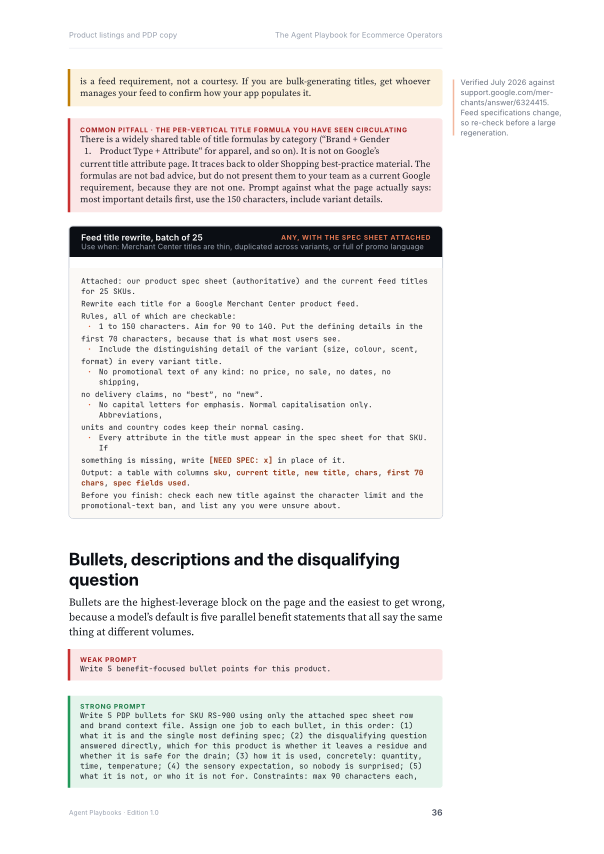
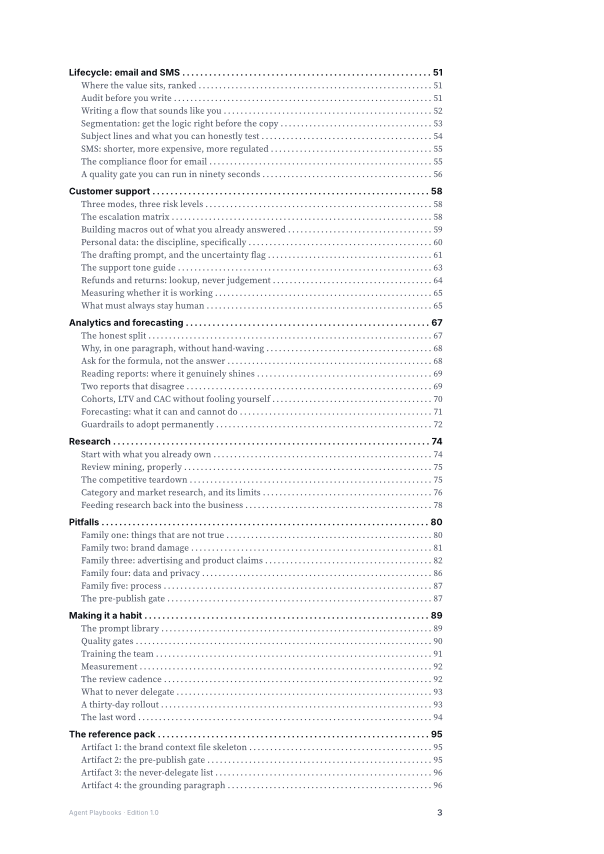
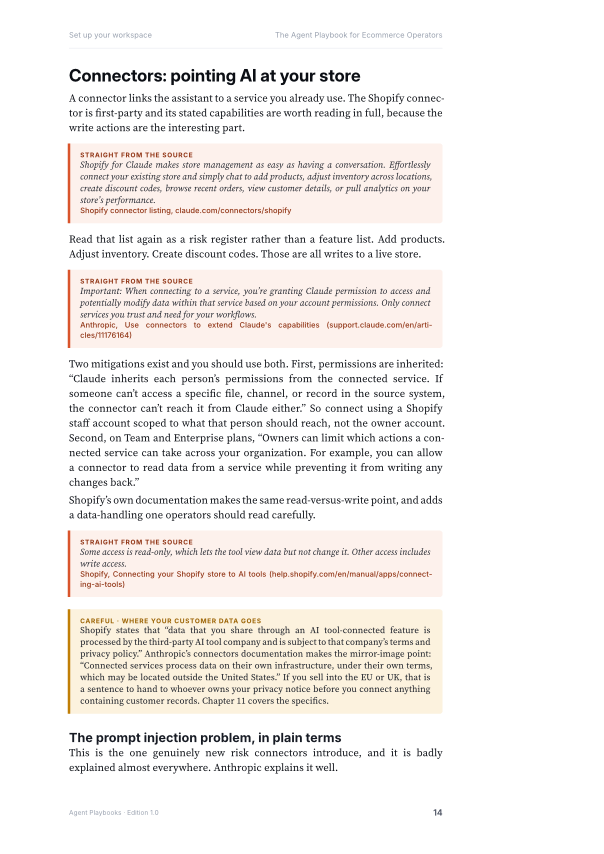
Real pages, not a mockup
This is what the inside actually looks like.
Renders of the real PDF. Every workflow gets the same treatment: the prompt in full, the weaker version of the same request, what the difference buys you, and the checklist that has to pass before anything reaches a customer.
The problem
The demo works. The six hundredth row is the problem.
Rewriting one product description with an AI tool is a five-minute win that anyone can reproduce. Rewriting six hundred of them is a different job: the tone drifts by row two hundred, an agent invents a fabric that is not in your data, a size chart quietly changes, and nobody notices until a customer does. Then the whole batch has to be reviewed by hand, which costs more than writing them would have.
The same shape repeats everywhere in a store. Lifecycle flows that sound like a different brand every third email. Support macros that answer confidently and incorrectly about your returns window. Ad variants that make a performance claim your legal team never approved. The failure is never the model being bad at English. It is a workflow with no source of truth, no refusal rule, and no gate between the output and the customer.
What it is
Workflows with gates, not a prompt library.
Every workflow in this book has the same four parts: the files the agent reads as its source of truth, the prompt in full, the things it is explicitly forbidden to invent, and the review step that has to pass before anything is published.
It is written to be platform-agnostic. Where a step depends on Shopify specifically, it is marked as such, and the CSV-and-API version is given alongside it so the same workflow runs on a different stack.
Read brand-voice.md and claims-policy.md before you start; both are binding. Input is one row of catalog-export.csv. Use only the attributes in that row. If an attribute is missing, leave it out. Do not infer materials, dimensions, country of origin, or care instructions. Write: one 12-word summary line, then 60 to 90 words of body, then three bullets of no more than 8 words each. Never make a health, safety, or performance claim that is not literally present in the input row. List every row you could not write honestly at the end.
One of thirty-four workflows, printed in full.
What's inside
Twelve chapters, 101 pages.
The full table of contents, in HTML, so you can read it before you decide.
- 01
Where AI actually pays in a store
The honest map: the jobs where a language model earns its seat, the jobs where it quietly does damage you will not notice for two months, and the one question that tells them apart before you bet the catalog on it.
- 02
Set up your workspace
Four kinds of thing get called "AI tools" and they are not interchangeable. What each is for, what it costs you in attention, and the setup a three-person team should have running by the end of the week.
- 03
The brand context file
One document, written once, pasted into everything. The difference between AI copy that sounds like your brand and copy that sounds like every other brand in your category, and the reason most teams give up in week three. Readable in full on the web.
- 04
Anatomy of a prompt that works
Five parts, in this order: goal, context, constraints, output format, review criteria. Operators do not fail at prompting because their phrasing is clumsy; they fail because they leave out four of the five.
- 05
Product listings and PDP copy
The largest block of stale, under-optimised text you own, and the one place where a fabricated fact does the most damage. The bulk workflow, the refusal rules and the review ramp.
- 06
Ad creative and copy
Cold-start angle generation is the weakest thing these tools do; iterating from what already performed is one of the strongest. Plus the claims review that keeps the ad account alive.
- 07
Lifecycle: email and SMS
The highest-volume writing surface you own, with the clearest feedback. Where an agent drafts, where it must not send, and how voice stays consistent across every flow.
- 08
Customer support
The highest-volume near-identical writing in your business, and the only place an AI mistake talks directly to a customer. The escalation rules are the chapter.
- 09
Analytics and forecasting
A language model is an excellent reader of your reports and an unreliable calculator inside them. Exploit the first fact, contain the second.
- 10
Research
Competitive teardowns, category maps, and the most under-exploited asset you own: several thousand words of customers telling you exactly what they think, sitting in your reviews and your inbox.
- 11
Pitfalls
Twenty-seven named failure modes, each with the tell that reveals it before a customer finds it. Several carry per-violation civil penalties; read this before you publish, not after.
- 12
Making it a habit
Most teams get three good weeks out of AI and then quietly stop, because nothing was written down and nobody owned it. The boring chapter that prevents that.
- App.
The reference pack
The brand context file skeleton, the pre-publish gate, the never-delegate list and the grounding paragraph, ready to copy.
One technique, in full
Ask for the refusals.
A complete guideline from the listing-copy chapter, printed exactly as it appears in the book.
Most catalog automation is graded on what it produced. That is the wrong end. The interesting output is the list of rows the agent could not write honestly, because that list is a precise inventory of where your product data is broken.
Weak
write SEO product descriptions for these items
Strong
use only the attributes present in each row. do not infer materials or origin.
            60 to 90 words. reject any claim not in the source data and list the rejected rows at
            the end
Without the refusal rule, an agent will fill a missing material field with "premium cotton blend" because that is the most probable text, not because it is true. The description reads well, passes a skim, and creates a returns problem and a compliance problem simultaneously. Adding "do not infer" changes the behaviour. Adding "list the rejected rows" turns a six-hundred-row proofread into a twenty-row data-cleanup task.
Run it on twenty rows first and read all twenty yourself. When something is wrong, fix the prompt rather than the output, then re-run the same twenty. Only once two consecutive passes are clean does the full catalogue go anywhere, and it goes to a staging collection in batches you can revert.
Why this matters more than tone
Voice drift is embarrassing and fixable next week. An invented material claim on a live product page is a regulatory exposure that dates from the moment it published. Guard the second one first.
The alternatives
Four ways to learn this. Three of them cost more than $79.
| Option | Cost | Time to useful | The catch |
|---|---|---|---|
| Blogs and YouTube | No cost | Weeks of digging | Plenty on AI marketing, almost nothing on running a real catalog through it with refusal rules and review gates. Undated, and nobody says when it changed. |
| Cohort courses | $500 to $1,000 | Scheduled weeks | Credible names charge this for a cohort. You get community and deadlines, and hours of video you cannot search mid-task. |
| Prompt dumps | Under $30 | Minutes | The sub-$30 tier is AI-generated prompt lists with no sourcing and no ratings. No refusal rules, no gates, and nobody stands behind a refund. |
| This playbook | $79, once | One evening | It is still a book. It will not run the workflows for you, and it makes no revenue promises. You do the work; it makes the work safe to repeat. |
Fit check
This will not suit everyone, so here is the honest split.
Buy it if
- You run or operate a store with real inventory and real customers.
- You are past the "does AI work" question and stuck on "how do I run this at volume".
- You are comfortable with a CSV export, a spreadsheet and a staging environment.
- You need to hand a workflow to someone else and have it still be safe.
- You would rather have 34 documented workflows than a subscription to another tool.
Skip it if
- You have not launched yet. Almost none of this applies before you have a catalogue.
- You want traffic or ad-buying strategy. This is about operations, not acquisition.
- You want a single tool recommendation. The book is deliberately platform-agnostic.
- You need someone to run it for you. This is a manual, not a service; Anodize takes implementation work separately, at anodizelabs.com.
- You are looking for revenue projections or income claims. There are none.
Before you decide
Read the brand-context chapter first. It is the full chapter, not a teaser.
Chapter three, the brand context file, is published in full as a web page: no email required, no gate, nothing to dismiss. It is the one document that decides whether AI copy sounds like your brand or like everyone else's. If it does not change how you brief your next prompt, do not buy the rest.
Pricing
One payment. Yours permanently.
No subscription and no recurring charge. Updates to this edition are included in the price and arrive by email. One honesty note: if you buy this guide, we will offer you the other playbook exactly once after checkout, at the bundle difference. That is the complete upsell; there is no third thing.
This guide
$79 one-time
The Agent Playbook for Ecommerce Operators.
- 101-page PDF, 12 chapters
- 34 workflows with prompts, refusal rules and gates
- Guardrail files and template pack index
- Updates to this edition included
- Instant access plus emailed link
Both guides
$149 one-time
Both playbooks: ecommerce operations and software engineering. $9 less than buying them separately.
- Everything in the ecommerce guide
- The Agent Playbook for Software Engineers
- Updates to both editions included
- Useful if you also maintain the store's code
Buying for a team? Five seats of both playbooks on one invoice:
Each guide is a paid digital book: one PDF, sold once. It is not software, and this page sells nothing else. Prices are in US dollars and shown before checkout. Payment is processed by Stripe; we never see your card details. Sales tax or VAT, where it applies, is calculated at checkout and shown before you pay.
Sixty days, no questions asked.
Email support@anodizelabs.com within 60 days of purchase and we refund you in full. You do not have to explain why, you do not have to delete the file, and there is no form. Refunds are issued to the original payment method and typically clear in five to ten business days.
The full policy is on the refunds page.
Not buying today
Take the five-day email course instead.
One workflow technique from this book per day for five days, by email. The same techniques you just saw on this page, in full. On day five we make the case for the book, once, and then the emails stop. No weekly newsletter, and the unsubscribe link works from the first message.
- Day 1 Ask for the refusals
- Day 2 Write the brand context file once
- Day 3 Twenty rows by hand, then six hundred
- Day 4 Draft with the agent, send with a gate
- Day 5 Let it read the reports, never write the numbers, and the offer
Questions
Answers, including the awkward ones.
What exactly do I get?
One PDF file, 101 pages, 12 chapters plus the reference pack. It is not a video course, not a software subscription, and not a members' area. After checkout you land on a page with your file, and the same link is emailed to you.
Is this a subscription?
No. It is a single payment of $79. There is no recurring charge and no trial that converts. After checkout we will offer you the other playbook once, at the bundle difference; declining costs nothing and changes nothing about your order.
Do I need to be on Shopify?
No. The workflows are written against CSV exports and generic APIs. Shopify-specific steps are labelled, and an equivalent path is given for other platforms.
Which AI tools does it assume?
Any agent that can read files and run in a terminal, plus any general assistant for the drafting workflows. The book names specific tools where behaviour differs but does not require a particular vendor.
Do I need engineers to use it?
No, but you do need to be comfortable exporting a CSV, editing a text file, and using a staging environment. Chapter two walks through the setup.
Will this increase my revenue?
We make no revenue or performance claims. This book is about doing operational work faster and with fewer errors. What that is worth depends entirely on your store.
Can I expense it?
Yes. Stripe emails a receipt with your details and, if you enter one at checkout, your company name and tax ID. For a formal invoice, email support@anodizelabs.com with your order reference.
Can I share it with my team?
The individual licence covers one person. The team tier covers five. Each purchased PDF carries the buyer's licence line on every page.
What if it is not what I expected?
Ask for a refund within 60 days and you get one, without explanation. See the refund policy.
Are you affiliated with Shopify or any AI vendor?
No. Agent Playbooks is independent and has no affiliation with, endorsement from, or sponsorship by Shopify, Anthropic, OpenAI, or any other company named in the book.
Read the sample chapter, then decide.
Same construction, same density, no email required. $79 once, instant access, and 60 days to change your mind.
101-page PDF · one-time payment · instant access · 60-day refund