For executives who set the budget
Most of the AI numbers on your slides will not survive a careful question.
A field manual for the decisions a C-suite actually makes about AI: what to fund, what to stop funding, who owns it, what it costs with the date attached, and how to measure it without relying on people's estimates of their own productivity. Every claim carries a named source, a sample size and a verification date.
Instant download after checkout, plus an emailed link. It is a PDF. Payment is handled by Stripe. 60-day refund, no questions asked.
- 114 pages
- Twelve chapters
- Sources dated and named
- Verified July 2026
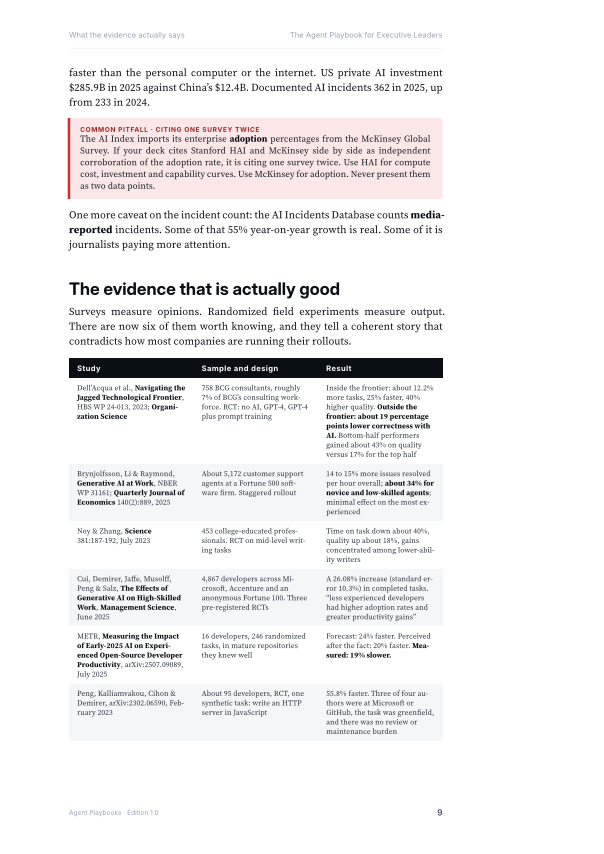
Real pages, not a mockup
This is what the inside actually looks like.
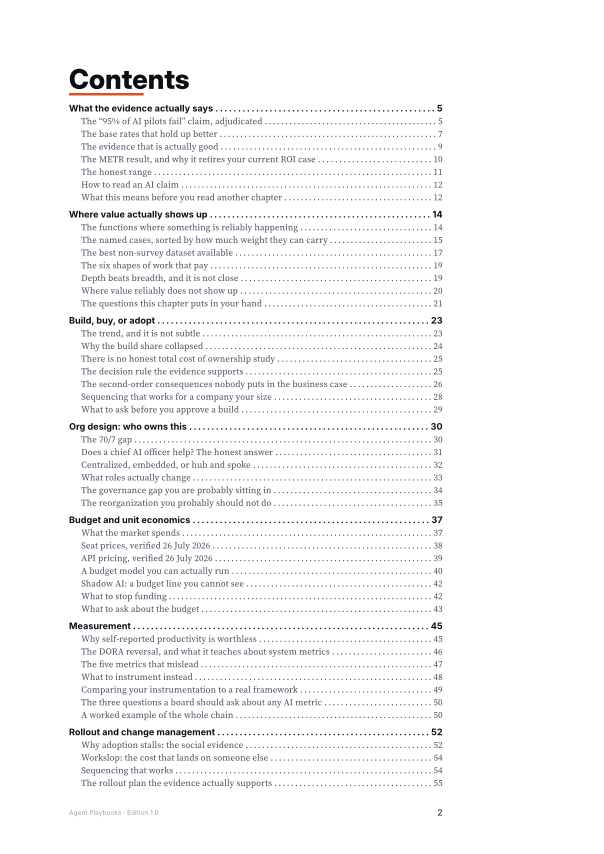
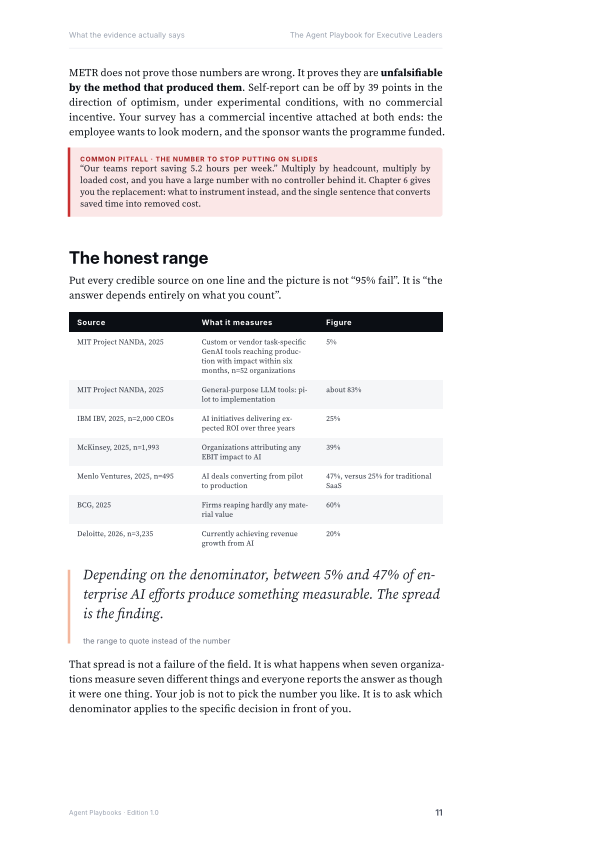
Every image below is a render of the real PDF. Typeset in Source Serif on a narrow measure with a wide margin for asides, so it reads like a published document rather than a deck exported to paper.
The problem
You are being asked to decide, using evidence nobody has checked.
A vendor shows you a 40% productivity gain. A consultancy shows you a failure rate. Your own team shows you a survey in which people estimated how many hours they saved. Each number arrives without a sample size, without a definition of success, and without the name of whoever funded the study. You are expected to approve a seven-figure programme against that.
The uncomfortable part is that the numbers are not usually fabricated. They are real measurements of something other than what they are being used to prove. The most quoted failure rate in the field is a production rate for one narrow category of tool. The most quoted productivity gain is a synthetic greenfield task measured by the vendor. And the one rigorous study that measured belief and output at the same time found that practitioners get the sign of their own productivity change wrong.
None of that means AI does not work. It means the evidence base is younger and weaker than you have been told, and that the people best placed to correct it are selling the remedy.
What it is
A decision manual, not a technology explainer.
You are not buying an explanation of transformers. The unit of value in this book is a decision: a budget defence, a vendor negotiation, a policy sign-off, a question to ask a CTO who is asking for $2M. Every chapter ends with something you can use in a meeting on Monday.
The method is consistent and it is the whole product. Every figure carries its source, its sample size, its date and its sponsor. Counted telemetry is labelled separately from self-reported survey numbers, because vendor reports print them on the same page and almost never distinguish them. Where a widely repeated number is weak, the text says so and shows the working. Where something could not be verified against a primary document, it says that too, at the point of use rather than in a footnote.
A worked example, from chapter one
"95% of AI pilots fail" and "83% of general-purpose LLM pilots reach implementation" come from the same paper, measured on different populations. The first is a production rate for custom, task-specific tools. The second is the pilot-to-implementation rate for tools like ChatGPT and Copilot. The paper is based on 52 structured interviews and 153 survey responses, is self-labelled preliminary, and the methodology quoted in the press (150 interviews, a 350-person survey) does not match the document.
That correction, in full and with the sources, is published free. It is a fair sample of how the rest is built.
What's inside
Twelve chapters.
Every title and description below is taken from the manuscript itself, not written for this page. The page count is marked TBD until the finished PDF is built, because a page count is a checkable claim and we will not print one we have not counted.
- 01
What the evidence actually says
The most quoted statistic in enterprise AI does not say what everyone quotes it as saying, and the methodology circulating in the press contradicts the paper it is drawn from. Also: the base rates that do hold up, the randomised trials that measure output rather than opinion, and how to read any AI claim put in front of you.
- 02
Where value actually shows up
The published wins cluster in a small number of shapes, and so do the published failures. Counted telemetry is separated from self-reported survey numbers, the named vendor cases are sorted by how much weight each can carry, and the categories of work where the evidence says not to expect a return are named.
- 03
Build, buy, or adopt
In two years the enterprise build share fell from roughly 80% to 24%, reversing the advice the market was giving in 2024. Why it collapsed, why there is no honest total cost of ownership study to lean on, the decision rule the evidence supports, and what to ask before you approve a build.
- 04
Org design: who owns this
The most quoted allocation rule says 70% of the effort belongs to people and process. The best available observation of what companies do says 7%. Whether a chief AI officer helps, what the evidence on that actually supports, and the reorganisation you probably should not do.
- 05
Budget and unit economics
Seat prices and API prices with a verification date on every line, because every vendor named repriced within eighteen months. A budget model you can run, the levers that move the bill by multiples rather than percentages, shadow AI as a line item you cannot see, and what to stop funding.
- 06
Measurement
Why self-reported productivity is worthless, the longitudinal dataset in which individual productivity rose while system stability fell, the five metrics that mislead, and the chain of leading and lagging indicators to instrument instead. Ends with a worked example of the whole chain.
- 07
Rollout and change management
Adoption does not stall for technical reasons. It stalls because using AI is socially risky for the individual, because the quality problem lands on the recipient, and because most leaders never published a plan that would make usage safe to admit. Six symptoms and what each actually means.
- 08
Risk and governance
Most AI policies govern the chat window and ignore the AI already shipped inside the CRM. Most vendor diligence asks one question where there are two. And insurers began writing generative AI out of general liability with 1 January 2026 effective dates, which almost nobody has checked.
- 09
Regulatory exposure
The European high-risk deadlines moved to December 2027 and August 2028, and Colorado's AI Act was repealed before it ever took effect. Most published guidance, including several popular tracker sites, is now simply wrong. This chapter is dated on every page for a reason.
- 10
Talent
Early-career workers in the most AI-exposed occupations show a 16% relative employment decline in administrative payroll records. The judgment layer AI cannot replace is precisely the layer that used to be produced by the junior roles it is displacing. The chapter does not pretend to have a comfortable answer.
- 11
Executive failure modes
Named failures, each with the tell you can spot in a meeting, the cause, and the fix. Every one traces back to evidence elsewhere in the book. This is the chapter to photograph and send to your leadership team.
- 12
The first 90 days
A sequenced plan with owners, artifacts and exit criteria. Ninety days is not arbitrary: it is the benchmark mid-market top performers hit from pilot to implementation, against nine months or more for large enterprises. Speed is the structural advantage a smaller company has.
The proof burden
At $199 the method has to be visible, so here it is.
Insight about AI is free. McKinsey, BCG and Deloitte publish executive-grade material at $0, and Microsoft, PwC, Cisco and RSM give away the readiness assessment specifically. This book cannot compete on insight and does not try to. It competes on whether you can check it.
Sample sizes on the page
No study is cited without its n, its design and its date. A survey of 1,993 self-selected respondents and a randomised trial of 4,867 developers are not the same kind of evidence and are not printed as though they were.
Sponsors named
When a figure comes from a company that sells the remedy, the text says so in the same sentence. That includes the vendors whose material is genuinely the best available.
Counted versus reported
Telemetry and self-report appear in the same vendor PDFs, usually on the same page, and almost never labelled. Here they are labelled, every time.
Prices carry expiry dates
Every seat price and API price in chapter five is stamped with the day it was verified, because every vendor in that table repriced within the preceding eighteen months and several repriced twice.
Corrections, not just claims
Where a widely circulated fact is wrong, the book says so and shows the primary document. Several of those corrections are things you can verify in five minutes, which is the point.
Unverified is written down
Where a source could not be resolved to a primary document, the text says that at the point of use instead of quietly asserting it. There is more of this than you would expect, and that is the honest state of the field.
Before you decide
Read the free brief. It is not a teaser.
Three corrections, published in full with every source linked and dated: where the "95% of AI pilots fail" figure actually comes from, the randomised trial in which developers were 19% slower while believing they were 20% faster, and the two governance dates that moved this year. No email required, nothing gated.
If it does not change a number you were about to use, do not buy the rest.
Fit check
This turns away more people than it suits.
At this price a bad fit is an expensive mistake for you and a refund for us, so the split is stated bluntly.
Buy it if
- You are C-suite, a VP or a founder at a company of roughly 50 to 5,000 people.
- You approve AI budgets, org structure, policy or vendor contracts.
- You have to defend a number to a board, a CFO or an audit committee.
- You would rather know which of your current figures are weak than be handed new ones.
- You want the questions to ask your CTO and your vendors, not the answers to memorise.
Do not buy it if
- You are hands-on. If you write prompts, build agents, or run the tooling yourself, this is the wrong book. It contains no prompt library, no configuration, and no implementation detail. Read the engineering playbook instead.
- You want a certification. There is no certificate, no accreditation and no credential. Nothing here goes on a LinkedIn profile.
- You want a cohort. There is no live session, no community, no Slack, no office hours and no instructor. It is a PDF. If you want a cohort, exec-ed programmes run from roughly $850 to $28,000 and several are good.
- You want AI explained. This assumes you already know roughly what these tools do and need to decide what to do about them.
- You want confidence. Large parts of this book reduce confidence in figures you currently hold, and it does not replace all of them with new ones.
Pricing
One payment. Yours permanently.
No subscription, no recurring charge, no post-purchase upsell. Updates to this edition are free and arrive by email at the address you check out with.
Individual
$199 one-time
The Agent Playbook for Executive Leaders, one seat.
- PDF, twelve chapters
- Every source named and dated
- Free updates to this edition
- Instant download plus emailed link
Team
$599 one-time
Ten seats, flat. The question sets in this book are meeting instruments, so a single seat is usually the wrong unit.
- 10 individually licensed copies
- One invoice, one checkout, no seat administration
- Free updates to this edition
- Still expensable by a director in most companies
Department
$999 one-time
Twenty-five seats, for a leadership group plus the people who will be asked to act on it.
- 25 individually licensed copies
- One invoice, one checkout
- Free updates to this edition
- Need more than 25? Email us
All three guides · $299 one-time
The executive guide plus both practitioner playbooks.
This book, The Agent Playbook for Software Engineers and The Agent Playbook for Ecommerce Operators. They are $357 bought separately. Useful if you want the executive view for yourself and something you can hand to the people who will do the work. Free updates to all three editions.
Prices are in US dollars and shown before checkout. Payment is processed by Stripe; we never see your card details. Sales tax or VAT, where it applies, is calculated at checkout and shown before you pay.
Why $199
The honest comparison, including the ones that do not flatter us.
You should be able to place this against what you already buy. These are list prices checked on 26 July 2026.
| What | Price | What you get for it |
|---|---|---|
| McKinsey, BCG and Deloitte AI publications | Free | Genuinely good executive material, published by firms that sell the transformation work |
| Harvard Business Review, "Generative AI" collection, 6 items | $99.95 | Six curated digital articles from the strongest brand in the category |
| Harvard Business Review, Financial Intelligence Set, 5 items | $195 | The credible upper bound for a package of documents from a peer-reviewed publisher |
| This guide | $199 | One PDF, one payment, sources named and dated throughout |
| The Economist, standard annual rate | $249 | A year of the publication, renewing every year |
| Wharton Executive Education, AI for Business | $850 | A programme, with instructors and a cohort |
| HBS Online, AI Essentials for Business | $1,949 | A course with a certificate |
| A single Forrester report | $2,995 | One analyst document |
| MIT xPRO, AI for Senior Executives | $28,000 | The top of this market |
Two things follow from that table and we would rather say them than have you notice them. First, Harvard sells five curated items for $195, and Harvard is peer-reviewed while we are not. This book has to be worth more per page than that comparison implies, which is why the whole product is the sourcing rather than the prose. Second, at $199 you are paying roughly 23% of the cheapest executive programme on that list and getting no instructor, no cohort and no certificate. If those things are what you want, the programmes are better value than we are, and several of them are good.
The price will go to $249 with a future edition, once there is enough named feedback to justify it. If you buy now you keep this edition and its updates at what you paid. That is the only urgency mechanic on this page, and it is a real one.
Sixty days, no questions asked.
Email support@anodizelabs.com within 60 days of purchase and we refund you in full. You do not have to explain why, you do not have to delete the file, and there is no form. Refunds are issued to the original payment method and typically clear in five to ten business days. Team and department licences are refunded on the same terms.
The full policy is on the refunds page.
Questions
Answers, including the awkward ones.
What exactly do I get?
One PDF file of twelve chapters. It is not a video course, not a Notion template, not a community and not a members' area. After checkout you land on a page with a download link, and the same link is emailed to you.
How long is it?
The page count is not final and we will not estimate one. When the book is built the number goes on this page and it will be the number of pages in the file you download. Every other page on this site carries a page count for the same reason: it is a verifiable claim, so it has to be verified.
Is $199 not a lot for a PDF?
It is more than most PDFs, and the comparison table above is there so you can judge it rather than take our word. The short version: the research behind it is the expensive part, insight in this category is free, and what you are paying for is that every figure is traceable and several widely repeated ones are corrected.
Is this a subscription?
No. It is a single payment. There is no recurring charge, no trial that converts, and no second product presented after checkout.
Will it be out of date in six months?
Parts of it will be. Vendor prices move, and at least one regulatory citation in it is still unresolved at the time of writing, which the book says on the page where it appears. That is why every version-sensitive claim carries a verification date rather than being asserted flatly. Updates to this edition are free and the changelog records what changed and when.
Is it just the consultancy reports summarised?
The consultancy reports are cited, and so are their methodological weaknesses: the sampling frames that are not published, the cross-sectional correlations presented as causal, and the fact that the firms publishing the failure rates sell the remedy. Where a primary source says something well it is quoted and attributed. The value is in the adjudication between sources that disagree.
Who wrote it? There is no author name.
Anodize Labs publishes under the company name and credits no individual. That is a deliberate choice: credibility here rests on whether the sources check out, not on a byline you would have to take on trust. Every claim carries the document it came from so you can go around us entirely.
Can I expense it?
Yes, and at this price most people can do so without pre-approval. Stripe emails a receipt with your name and, if you enter one at checkout, your company details and tax ID. For a proper invoice, email support@anodizelabs.com with your order reference. Team and department licences are invoiced on request.
Can I share it with my team?
The individual licence is for one person. The team tier covers ten people and the department tier covers twenty-five. Sharing one copy more widely is not permitted, and each downloaded PDF carries the buyer's licence line on every page.
Do you offer a certificate or a cohort?
No, and we do not intend to. If a credential is what you need, executive education programmes provide one and this does not.
What if I buy it and it is not what I expected?
Ask for a refund within 60 days and you get one. No questions, no form. See the refund policy.
Are you affiliated with any vendor or research firm?
No. Agent Playbooks is independent and self-funded, takes no money from any tool vendor, and has no affiliation with, endorsement from or sponsorship by any organisation named in the book.
Read the free brief, then decide.
The brief is three corrections with every source linked and dated, and it is the same method as the rest of the book. If it changes a number you were about to put on a slide, the other chapters are built the same way. $199 once, instant download, and 60 days to change your mind.
PDF · one-time payment · instant download · 60-day refund